Gene silencing is an extremely important phenomenon occurring within cells to control processes such as homeostasis and development. This is achieved through the alteration of gene expression patterns via various mechanisms. The significant advancements in molecular biology have placed considerable pressure on the development of gene silencing techniques to study gene function and regulation and to address fundamental questions. The discovery and development of RNA interference is undoubtedly a groundbreaking achievement in the field of molecular biology.
In 1998, Andrew Fire and Craig Mello observed an unexpected phenomenon when they introduced double-stranded RNA (dsRNA) into the nematode worm Caenorhabditis elegans. The introduction of dsRNA induced sequence-specific mRNA degradation and, consequently, gene silencing. Their discovery of RNA interference earned them the Nobel Prize in Physiology or Medicine in 2006.
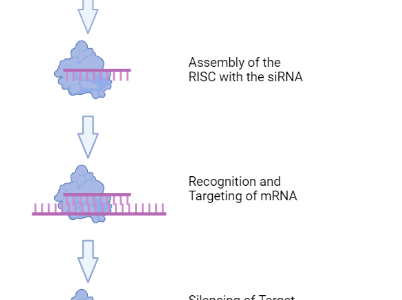
The mechanism of RNA interference (RNAi) is complex and fascinating. It involves small RNA molecules, such as microRNAs (miRNAs) and small interfering RNAs (siRNAs), which guide the RNA-induced silencing complex (RISC) to specific messenger RNA (mRNA) targets. However, in this article, we will focus only on siRNAs, as we are interested in RNAi as a tool for molecular biology. Here is a detailed step-by-step explanation of the RNA interference mechanism:
1- siRNA Biogenesis: siRNAs can be introduced exogenously (designed using bioinformatics tools and synthesized by industrial companies) or arise endogenously from viral RNA or transposable elements. siRNAs, which are 20-30 nucleotides long, are generated through the processing of dsRNAs by a specific endonuclease called Dicer. This step is usually bypassed if the siRNAs are of the correct length.
2- Assembly of the RNA-Induced Silencing Complex (RISC): The siRNA is then unwound by a helicase. One strand, known as the passenger strand, is degraded, while the other strand, the guide strand, is incorporated within RISC. RISC contains the Argonaute protein (responsible for RNA cleavage) and other proteins like GW182.
3- Recognition and Targeting of mRNA: Equipped with the guide RNA, RISC scans the cytoplasm for target mRNA to silence. The siRNA binds with perfect complementarity to the target region on the mRNA.
4- Silencing of Target mRNA: Upon recognition, the AGO protein cleaves the target mRNA, leading to its degradation.
RNAi has proven to have numerous applications in both basic and translational research and medicine. RNAi can be utilized in gene function studies, enabling scientists to silence genes of interest for studying their roles. In therapy, novel gene therapy techniques involve delivering siRNAs to silence disease-related genes or viral mRNAs. Delivery methods include liquid emulsions or viral vectors. The future of RNAi applications is promising as our understanding of disease mechanisms deepens. RNAi-based therapies tailored to individual patients’ genetic profiles could become a reality, offering personalized and more effective treatments.
Defining a “leap” in molecular biology can be challenging. However, RNAi is undoubtedly a leap as it has provided a revolutionary tool for studying gene regulation and function, and it holds great potential in medicine and possibly agriculture. The discovery and application of such tools have laid a solid foundation for our practical approach to fundamental molecular biology research. Another leap is the discovery of CRISPR. Several questions arise: what truly constitutes a leap in biology? What other discoveries can we consider as leaps?
References:
1. Fire, A., Xu, S., Montgomery, M.K., Kostas, S.A., Driver, S.E., and Mello, C.C. (1998). Potent and specific genetic interference by double-stranded RNA in Caenorhabditis elegans. Nature 391, 806–811. 10.1038/35888.
2. Ambesajir, A., Kaushik, A., Kaushik, J.J., and Petros, S.T. (2012). RNA interference: A futuristic tool and its therapeutic applications. Saudi J Biol Sci 19, 395–403. 10.1016/j.sjbs.2012.08.001.
3. Svoboda, P. (2020). Key Mechanistic Principles and Considerations Concerning RNA Interference. Frontiers in Plant Science 11.

 RNA Stuff