Comparative Genomics and the Boundaries of Molecular Rules
The evolution of life on Earth is a history of countless successes and failures. The variations arise through chance, but within physical, chemical, and biological organization and limitations. Natural selection acts on these variations, retaining forms that remain functionally viable, while many other variations persist through neutral evolution, shaped not by adaptive advantages but by … Continue reading Comparative Genomics and the Boundaries of Molecular Rules
Why evolution needs noise: in the light of QT45 ribozyme

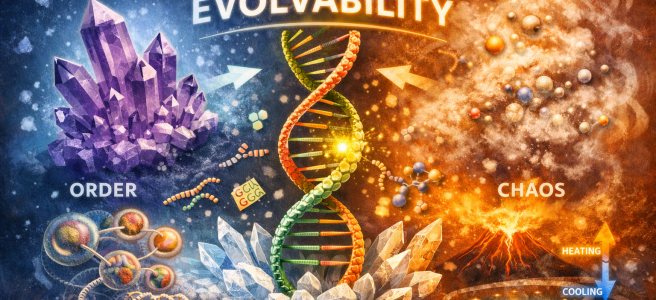
A violet amethyst crystal, while beautiful on the outside, is a highly ordered structure at the microscopic level, and therefore cannot evolve. In contrast, a gas is highly random and cannot store any form of structure or information. Life sits right there in the middle, a highly structured and complex system with a tolerated degree … Continue reading Why evolution needs noise: in the light of QT45 ribozyme

DNA Replication and Convergent Evolution: How Life Reinvented a Core Process

Since the very beginning of life, organisms have needed a way to store and pass on information. Current knowledge suggests that the first form of genetic information was stored in ribonucleic acid (RNA). Over time, life invented DNA, a chemically more stable molecule, for long-term information storage and faithful inheritance across generations. This genetic information … Continue reading DNA Replication and Convergent Evolution: How Life Reinvented a Core Process