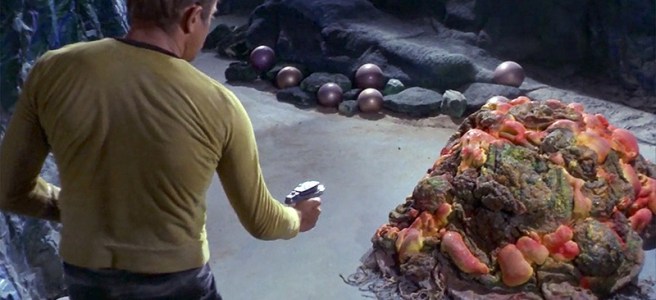
In the original Star Trek series, the crew of the spaceship USS Enterprise faced a silicon-based life form called Horta. Of course, this is all science fiction. But is it possible for life to be based on elements other than carbon? If yes, then we are looking in the wrong direction for extraterrestrial life, and it will become much more complicated to find it. A lot of research is being done to answer this question, with silicon as the star alternative to carbon to form the backbone of life’s macromolecules.
Life on Earth utilizes various biochemical molecules such as lipids, amino acids, sugars, and nucleic acids. All of these molecules contain carbon as a fundamental component. This makes life on our planet carbon-based. But why did nature rely mostly on carbon and not other elements?
Carbon is an abundant element in Earth’s crust. One of the most important characteristics of carbon is its versatility in terms of bonding, as carbon can form four strong covalent bonds with other atoms. Also, not to forget that carbon-carbon bonds are highly stable under a wide range of conditions. Furthermore, long chains of carbon atoms, which can even form isomers, are stable. In addition to the ability of carbon to form stable bonds with two essential elements for life, namely oxygen and hydrogen, carbon-based molecules are highly compatible with water, which acts as a universal solvent for life and is quite abundant on Earth. All these factors make carbon the perfect element for life on Earth. Yet, when we talk about extraterrestrial life, we shouldn’t have any pre-dispositions on what element, solvent, or conditions life requires.
What are the possible candidates as elements for life? The main talk is around silicon, and some even go further to think about arsenic. Silicon is the closest to carbon in terms of characteristics, but it has some limitations. Silicon has the same tetravalency as carbon and can form silicon-silicon bonds, but they are weaker than carbon-carbon bonds. The tricky part regarding silicon is the possible solvent. In water, only a small portion of silicon chemistry is stable. Silicon can form multiple stable bonds in solvents such as sulfuric acid and other solvents such as methane. Silicon-based life is not favorable on Earth as oxygen and silicon can form silica, which is a solid. Yet, it may be possible on other planets having favorable conditions for silicon-based life to flourish.
Conditions on Earth provided the perfect environment for carbon-based life to exist. The abundance of carbon in Earth’s crust and atmosphere, as well as the perfect temperature and distance from the sun for liquid water to be the solvent for life’s biochemistry, are factors that were perfect. Scientists are looking, and they have already found indeed, for other planets that have the same composition of Earth’s crust and atmosphere and temperature. In this way, we hope to find life forms that evolved the same way life evolved on Earth.
Why should life on other planets be the same as on Earth? Why should it need the same conditions? Almost every single planet out there can provide a perfect environment for some sort of life that is very different from life on Earth and relies on different elements and conditions. Finding such life expands our search parameters to an extent that is almost impossible to cover, but unfortunately, this is what it is.
It is fundamental to science that when you go after something that wide, not to have any pre-dispositions that are based on very limited variables in order to see the wide and clear image. This is the case when you look for life beyond Earth. Yet, here our technological abilities accompany us as a limiting factor for our hunt. One more question which opens doors, and I will leave it for you to think about: if we found a silicon-based life form, can we ever communicate with it?

 RNA Stuff