Last week, I was the at the 30th tRNA conference in Greece. The great food and the soft breeze of the Mediterranean made me lazy to think beyond tRNA business; which is still my main interest nevertheless. Once I landed in Czechia, it came to my mind how much of an experience is a conference. … Continue reading Conferences as a compressed view of science

Tag: biology
The Invisible Education of PhD Life
Over dinner with a distinguished parasitologist, our PI told us that something very important about science is that it makes you meet very interesting people. The formal PhD experience is generally seen as the process of doing experiments, analyzing results, publishing papers, and taking courses. While this is what is usually seen in your CV, … Continue reading The Invisible Education of PhD Life
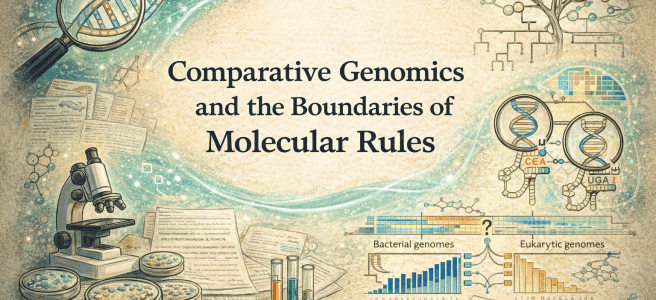
Comparative Genomics and the Boundaries of Molecular Rules
The evolution of life on Earth is a history of countless successes and failures. The variations arise through chance, but within physical, chemical, and biological organization and limitations. Natural selection acts on these variations, retaining forms that remain functionally viable, while many other variations persist through neutral evolution, shaped not by adaptive advantages but by … Continue reading Comparative Genomics and the Boundaries of Molecular Rules
DRT3 and the Creativity of Molecular Biology
A recent Science paper described an extremely strange antiphage reverse transcriptase system, DRT3. DRT3 is made up of two RT-like proteins, DRT3a and DRT3b, and a non-coding RNA. These assemble into a large ribonucleoprotein complex with six copies of each component. Functionally, the two RTs make opposite strands of an alternating dinucleotide DNA repeat. DRT3a … Continue reading DRT3 and the Creativity of Molecular Biology
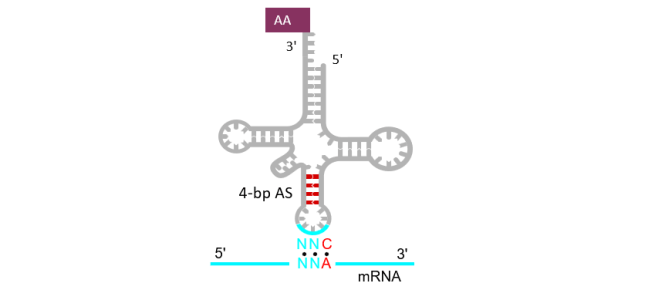
The 4-bp anticodon stem tRNA: an anarchist of the genetic code
In our genetics 101, we often learn that the genetic code is a strict dictionary. But biology, as we know it, is the wonderland of exceptions. In fact, the genetic code can only be called “nearly universal”, since up to 60 deviations have been described so far (Lukes et al. Curr. Biol., 2025). Departures sometimes … Continue reading The 4-bp anticodon stem tRNA: an anarchist of the genetic code
Why evolution needs noise: in the light of QT45 ribozyme
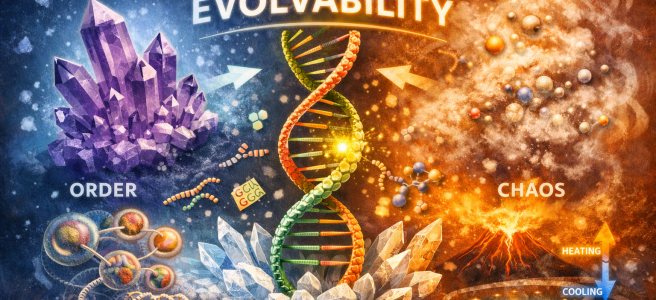
A violet amethyst crystal, while beautiful on the outside, is a highly ordered structure at the microscopic level, and therefore cannot evolve. In contrast, a gas is highly random and cannot store any form of structure or information. Life sits right there in the middle, a highly structured and complex system with a tolerated degree … Continue reading Why evolution needs noise: in the light of QT45 ribozyme
Origin of protein translation: a factory that built itself
Information is one of the first words that comes up whenever people try to define life. Any living system must be able to store information and pass them on to the next generation. The stored information are instructions used to build the structures and functions necessary for cellular life to operate such as metabolism, membranes, … Continue reading Origin of protein translation: a factory that built itself