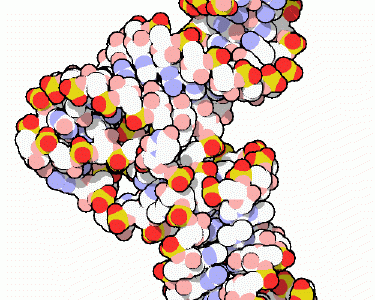
A transfer RNA (tRNA) was originally seen as a boring adaptor that brings amino acids to the ribosome during protein translation. A tRNA, with its distinct 2D cloverleaf structure, has an amino acid attached to its acceptor stem and the anticodon which recognizes a specific codon in the messenger RNA. Yet, further experiments showed that tRNAs play further roles in several biological processes. One recently described process where a tRNA has a non-canonical function is RNA editing in kinetoplastids.
Kinetoplastids represent an early branching lineage of eukaryotes that develop various peculiar molecular inventions. They are distantly related to well-studied model organisms like animals and insects. Their relevance is medical and economical as they include human (and cattle) pathogens like Trypanosoma brucei. However, beyond this relevance, they act as a “magnifying lens” for molecular and evolutionary biology. Perhaps, and this is a little subjective on my side, the most interesting feature is their absurdly complex mitochondrial RNA editing machinery.
The mitochondrial genome of kinetoplastids is made up of various circular DNA fragments, maxicircles and minicircles. Maxicircles express many initially incomplete or non-functional mRNA transcripts. These transcripts are then edited by the editosome with the help of guide RNAs (gRNA) found in the minicircles. The editing proceeds through mRNA cleavage, uridine addition or removal, and RNA ligation. These reactions are performed by large protein-RNA assemblies involving the substrate-binding RESC and catalytic RECC complexes. The entire complex phenomenon is considered one of the fine examples of constructive neutral evolution. Yet, the organization of this dynamic machinery had remained poorly understood.
Using cryo-electron microscopy, Liu et al 2026 uncovered a tRNA-shaped density embedded within both RECC1 and RECC2. Subsequent RNA sequencing and biochemical experiments identified a nuclear-encoded mitochondrial tRNAValAAC is selectively enriched. Its acceptor stem and other structural regions contact editosome proteins, and it physically bridges the central RNase III-containing catalytic code with the peripheral “wing” assemblies. The tRNA behaves as an architectural scaffold that helps position modules involved in the final RNA-ligation step.
tRNAs are frequently edited as substrates. For example, the cytosine at position 34 of tRNA-Trp of kinetoplasits is edited to uridine upon import to the mitochondria. Also, enzymes that edit tRNAs are sometimes recruited to edit mRNAs. tRNAs could also act in cell-wall synthesis, lipid modifications and other metabolic pathways. Nevertheless, a mature canonical tRNA acting as an integral architectural component of a machinery that edits another RNA appears to be unprecedented. The tRNA architecture and fold are ancient, stable and rich in potential interaction surfaces. This makes a tRNA molecule suitable for recruitment as a structural component. This discovery expands the functional repertoire of tRNAs. Evolutionarily, it shows that molecular machines do not only evolve through gene duplication, but through recruiting other structured RNAs. It also shows how one single molecule evolved for a certain purpose could be utilized in the soup of the cell for other functions while keeping its canonical function. In the trypanosome editosome, tRNA is no longer merely an adaptor between codons and amino acids; it has become part of the physical architecture through which genetic information is repaired.
Best regards,
Fadel
Reference:
Liu, Y.-T. et al. Structural basis of the RNA-editing cascade in trypanosome mitochondria. Nature https://doi.org/10.1038/s41586-026-10831-x (2026).
Image source:


