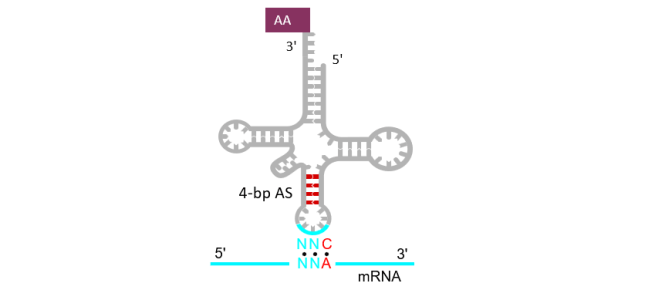
In our genetics 101, we often learn that the genetic code is a strict dictionary. But biology, as we know it, is the wonderland of exceptions. In fact, the genetic code can only be called “nearly universal”, since up to 60 deviations have been described so far (Lukes et al. Curr. Biol., 2025). Departures sometimes come from the subtle changes in the molecules that read it. Transfer RNAs (tRNAs) are the adaptors that decode codons into amino acids. These adaptors are not passive ones per se, small structural or biochemical changes in tRNAs can alter decoding behavior. Recently, colleagues in our lab, along with collaborators, uncovered a peculiar deviation in the anticodon stem of the tRNA-Trp in the parasite Blastocrithidia nonstop (Kachale et al. Nature, 2023). A deviation that we managed to generalize beyond eukaryotes, to bacteria, in our very recent publication in Nucleic Acids Research (Fakih et al. NAR, 2026).
The anticodon stem to stop: 4 or 5?
The genetic code rebel, B.nonstop, recoded all three stop codons to sense codons. While UAA and UAG each have a fully cognate suppressor tRNA-Glu to decode them, the parasite evolved a tRNA-Trp with a 4-base-pair long anticodon stem (4-bp AS) to read UGA. This structural deviation, namely the unpinning of the top base pair of the stem and not shortening it, enables the unlikely to happen C:A pairing at the wobble position (See featured image). This allows a CCA anticodon of tRNA-Trp to read the near-cognate codon UGA. This 4-bp AS deviation is also utilized by the ciliate Condylostoma magnum to reassign UGA to trp.
The first questions that come to mind are: is this deviation specific to these cases of B.nonstop and C.magnum? or is this structural solution adopted across cellular life in general? To answer this question, we went after bacterial tRNAs to generalize the phenomenon beyond eukaryotes into another domain of life. We asked: how common are these 4-bp AS tRNAs in bacterial genomes? Are such tRNAs limited to one tRNA type, or distributed broadly among other isoacceptors? Can this structural deviation work within the context of the prokaryotic ribosome?
An atlas of bacterial tRNAs: 4-bp AS tRNAs are not rare
We performed a comprehensive analysis across all available 42k bacterial genomes on the Genome Taxonomy Database, predicting their genetic codes and their tRNA genes. We generated an atlas of bacterial tRNA by predicting around 1.7 million bacterial tRNAs, available in the supplementary data of the paper. We found that these 4-bp AS tRNAs represent the second most common length of the AS (5.6%), just behind the canonical 5-bp variant (94.2%). In fact, the tRNAs in bacteria seem to cluster into two main groups based on AS length, 5- and 4-bp AS. In addition to occurring across diverse bacteria, we found that the occurrence pattern of these tRNAs is broader than just tRNA-Trp. Therefore, what looked like an unusual edge case turns out to be part of a much broader structural diversity in bacterial tRNAs.
Some of these tRNAs seem to be linked to decoding UGA. From a genetic code lens, in our study, we discovered 4 new genomes with UGA-to-Trp reassignment in the phylum Patescibacteriota, where UGA is decoded by a suppressor tRNA-Trp with a UCA anticodon. Interestingly, in the bacterium Ca. Zinderia insecticola, with UGA-to-Trp reassignment, a suppressor tRNAs appears to be missing. Zinderia has only a 4-bp AS tRNA-Trp CCA, which would be the only solution for the bacterium to decode its in-frame UGA codons.
Our results support an extended superwobble hypothesis (more below). We investigated some theoretical implication of such proposed hypothesis and found cases, for example, when the tRNA with CNN anticodon has a 4-bp AS, the tRNA-UNN becomes dispensable. In such cases, the 4-bp AS tRNA CNN should, in theory, decode both the fully-cognate G-ending codon (NNG) and the near-cognate U-ending codon (NNU).
The 4-bp AS tRNA-Trp decodes UGA in Escherichia coli
Beyond our massive genomics analysis, we opted to experimentally prove that the 4-bp AS tRNA enables C:A paring in bacteria. We overexpressed both variants of the tRNA, the wild-type 5-bp and a mutant 4-bp, and noticed that the 4-bp AS tRNA-Trp promotes significantly higher readthrough than the 5-bp AS variant.
Mechanistically, our collaborators performed molecular dynamics simulations on the E.coli tRNA-Trp testing various variants of the unpinned top base pair of the AS. Interestingly, the experimentally tested C27A mutation, which results in a 4-bp AS tRNA-Trp, showed a G24A-like mechanism where it promoted stabilization of the A/T conformation required for GTP hydrolysis in the ribosome-elongation factor-tRNA ternary complex. This G24A mutation is a well-studied deviation that promotes UGA stop codon readthrough by the tRNA-Trp CCA. While we don’t know if the deviation still promotes C:A pairing in other tRNA species, we are sure that this deviation is functional in tRNA-Trp with a mechanistic explanation based on the well-known G24A mutation.
An extended superwobble hypothesis: why does it matter?
In this work, we combined comparative genomics, phylogenomics, molecular biology experiments, and structural modeling to expand the phenomenon of 4-bp AS=C:A pairing beyond eukaryotes. Thus, we propose an “extended superwobble hypothesis” that renders an “unlikely-to-happen” C:A pairing as the norm when we have a 4-bp AS tRNA CNN.
But why does it matter at all? Classical wobble rules already tell us that decoding is more flexible than exact Watson-Crick pairing. Superwobble, where a tRNA with an unmodified U at the wobble position can decode all 4 codon boxes, expanded the picture. Our work argues that the framework should be extended again to account for the C:A pairing. What our work really emphasizes is that tRNAs are not passive adaptors, even small structural changes in a tRNA, with certain tolerated flexibility, can lead to altered decoding fidelity. More broadly, this suggests that new decoding capacities can evolve through small changes in a pre-existing tRNA, making genetic code changes more mechanistically accessible.
Our work sheds light on the extended anticodon hypothesis, where the codon meaning is not always predicted from the anticodon sequence of the tRNA alone. Selection then acts not only on anticodon identity, but also on the tRNA architecture itself. Finally, this framework has consequences for how we interpret tRNA repertoires across genomes, because it implies that selection can either favor such structural flexibility when it is useful or eliminate it when it becomes deleterious.
I would like to thank all my colleagues and collaborators for their great effort and valuable contributions that they made to get the job done. Good job everyone!
Best regards,
Fadel
References:
Fakih, F. et al. Frequent occurrence and predicted functions of tRNAs with 4-base-pair anticodon stems in bacteria: extended superwobble hypothesis. Nucleic Acids Res. 54, gkag327 (2026). https://doi.org/10.1093/nar/gkag327
Kachale, A. et al. Short tRNA anticodon stem and mutant eRF1 allow stop codon reassignment. Nature 613, 751–758 (2023). https://doi.org/10.1038/s41586-022-05584-2
Lukeš, J. et al. Natural and artificial variations of the standard genetic code. Curr. Biol. 35, R1104–R1126 (2025). https://doi.org/10.1016/j.cub.2025.09.071
The cover image was made on Biorender.


