A recent Science paper described an extremely strange antiphage reverse transcriptase system, DRT3. DRT3 is made up of two RT-like proteins, DRT3a and DRT3b, and a non-coding RNA. These assemble into a large ribonucleoprotein complex with six copies of each component. Functionally, the two RTs make opposite strands of an alternating dinucleotide DNA repeat. DRT3a behaves like a canonical reverse transcriptase by using a conserved ACACAC motif in the ncRNA as a template to synthesize a GTGTGT, a DNA strand. On the other hand, DRT3b, incredibly, synthesizes the complementary ACACAC DNA strand without a nucleic-acid template, apparently using protein active-site residues to enforce A/C alternation. The final product is alternating poly(GT/AC) double-stranded DNA. This means that a protein synthesizes DNA!! Isn’t that cool?! The story goes beyond. In this paper, the team found that the process seems to be conserved across bacteria as homologs of DRT3 have been identified across 20 bacterial phyla.
The discovery is fascinating. It extends the toolbox of bacterial defense against phages and adds another innovative solution created by evolution. More importantly, it expands our view of what reverse transcriptase-like enzymes can do. This means that sequence order in a nucleic-acid polymer can, in rare and constrained cases, arise not only from a nucleic-acid template but also from the architecture of a protein complex.
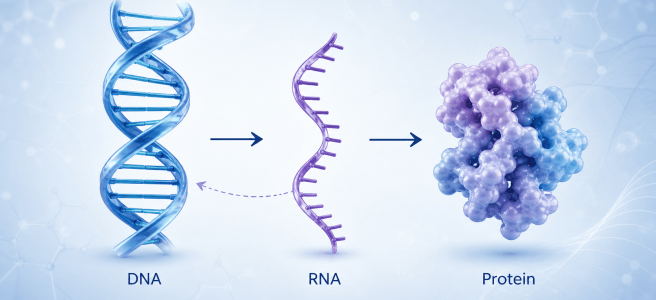
What does the discovery mean to the central dogma? Does such discovery imply that we should change our textbooks? In our molecular biology 101, we got introduced to the fact that DNA (and RNA in viruses) stores the information needed to build the structural and functional molecules of the cell (the proteins) through RNA as an intermediate and as a regulator. Francis Crick defined the central dogma of molecular biology as “the detailed residue-by-residue transfer of sequential information. It states that such information cannot be transferred from protein to either protein or nucleic acid.” Thus, for the molecular dogma to be violated, the amino acid sequence of protein must be “reverse translated” into nucleotides. This is not the case for DRT3b. DRT3b contains structural information in its active site. That architecture constrains which nucleotide is added next, producing an alternating ACACAC DNA strand. In that sense, the protein carries “instructions” for a simple pattern and does not act as a sequence-based template for DNA synthesis.
Therefore, the broader implications of DRT3 do not mean that the central dogma has collapsed, but that the molecular routes to biological order are more diverse than textbook diagrams suggest. Congratulations to the authors on an inspiring study that reminds us how much evolutionary innovation remains hidden in the molecular world.
Best regards,
Fadel
References:
Deng, P., Lee, H., Armijo, C., Wang, H. & Gao, A. Protein-templated synthesis of dinucleotide repeat DNA by an antiphage reverse transcriptase. Science (2026). doi:10.1126/science.aed1656.
Crick, F. Central dogma of molecular biology. Nature (1970). doi:10.1038/227561a0.
The featured image was created using ChatGPT.


