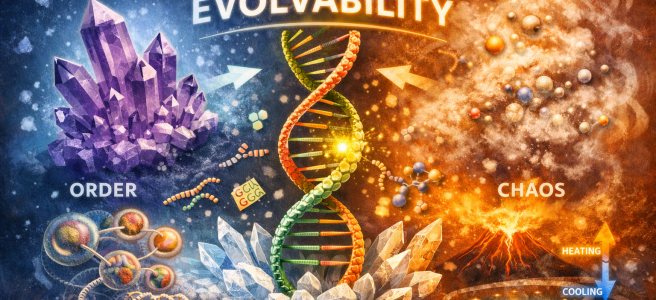
A violet amethyst crystal, while beautiful on the outside, is a highly ordered structure at the microscopic level, and therefore cannot evolve. In contrast, a gas is highly random and cannot store any form of structure or information. Life sits right there in the middle, a highly structured and complex system with a tolerated degree of change and novelty. This specific balance achieved by life on Earth for around 3.7 billion years tells us a lot about the origin of life and its evolution. Systems that undergo Darwinian evolution, and other types of pre-biotic evolution, must be able to balance fidelity (to preserve function) with error (to explore). In other words, evolution is the art of keeping disorder just low enough to be useful, to provide evolvability to the system.
Structured information and randomness in biology
In a biological system, the information is canonically referred to as the genetic information stored with the genome of the biological entity, DNA for cellular life and DNA or RNA for viruses. But genomes don’t act in isolation. Biological information also includes heritable states and constraints that live outside the sequence like chromatin state, regulatory networks, cell structure, among others. This information acts as a blueprint to build the defined structures and borders of the cell and the functional tools to sustain it. Therefore, a cell is arguably a highly organized automaton.
On the other hand, randomness, in a biological system, generally represents the mutations that occur within the genes of the cell. These mutations include point mutations, insertions, deletions, etc. In addition to sequence variations, events like the duplication of a gene/genome or recombination during crossing over contribute to the randomness that fuels novelty. Remarkably, duplication contributes significantly to cellular innovation as it creates redundancy that can mutate without collapsing the system.
Minimal ingredients of Darwinian evolution
A simple recipe of Darwinian evolution has three ingredients. The first is replication. Genomes must be replicated in order to be eventually inherited by the offspring. Genome replication, as a process, is universally conserved across cellular life. The other ingredient, and perhaps the source of chaos, is variation. During DNA replication, errors can occur. These errors are thus inherited to the offspring in unicellular organism, and sometimes in multicellular organisms. The errors could lead to a process of differential survival. The error in genome replication can be beneficially, giving the organism an edge over its peers, or deleterious, giving the organism lower chance of survival compared to others.
Therefore, variation must be nonzero but bounded. The variation must be kept within an error threshold. The effect of the variation is selected against if it hits a functionally or structurally important residue that would cause lower fitness and chance to survive and reproduce. On such variations, selection acts to eliminate the deleterious and keep the beneficial. Thus, noise could be useful for exploration and randomness becomes a productive perturbation.
RNA: structures and information
RNA is nucleic acid; a macromolecule life uses to store information. But RNA molecules carry more than mere sequences of nucleotides, they usually fold into complicated structures. In fact, it is such structures that give the RNA molecules their catalytic capacities.
Ancient RNA molecules needed structures made of relatively long sequences to catalyze their primitive reactions. However, these long sequences are challenging to be replicated. Function pushes RNA toward stable folds while replication pushes it toward exposure. The earliest evolvable RNAs had to satisfy both. Noise becomes now not just as error, but also the physical limits and fluctuations that prevent the system from freezing into an inert attractors. The noise that promotes evolvability is the one that keeps disorder at tolerable rates preventing it from reaching a dead end.
QT45 under the lense
Initial attempts to generate a self-replicating RNA molecule failed on the hurdle of the length of the sequence, discussed in the last paragraph. The sequences that retained functionality were just too long to possibly exist in prebiotic times. QT45, a 45 nucleotide-long polymerase ribozyme capable of self-replicating without any protein, represents a breakthrough toward understanding how the very first ribozymes looked like. But seen through the lens of function, structure, and length, QT45 is less as a new “record-holder” and more a proof that the balance between structure and disorder can be engineered into the environment, not only into the molecule. The ribozyme is extremely short, yet it operates in eutectic ice, an approach that concentrates reactants and alters kinetic bottlenecks in ways that can support RNA replication. In parallel, using triplet building blocks changes how templates are engaged: triplets can help invade and unravel structured regions that would otherwise stall copying, shifting the fold-copy conflict into a more permissive zone. In other words, the ‘noise budget’ that makes evolvability possible is not just the mutation rate; it also includes the system’s non-equilibrium scaffolding, freeze-thaw-like compartmentalization, fluctuating accessibility, and mechanisms that intermittently disrupt duplex dead ends.
Therefore, QT45 reminds us that evolvability is achieved through tuning noise: enough disorder to keep replication from collapsing into dead ends, yet enough fidelity to maintain functions and structures. In that sense, in addition to mutations, noise includes physical cycling and environmental heterogeneity that can sustain the space of possible sequences and reactions. The origin of life challenge is about finding the right corridor of useful disorder.
Best regards,
Fadel
References:
Gianni, E. et al. A small polymerase ribozyme that can synthesize itself and its complementary strand. Science 391, 1022–1028 (2026). https://doi.org/10.1126/science.adt2760
The image was generated using ChatGPT

 RNA Stuff